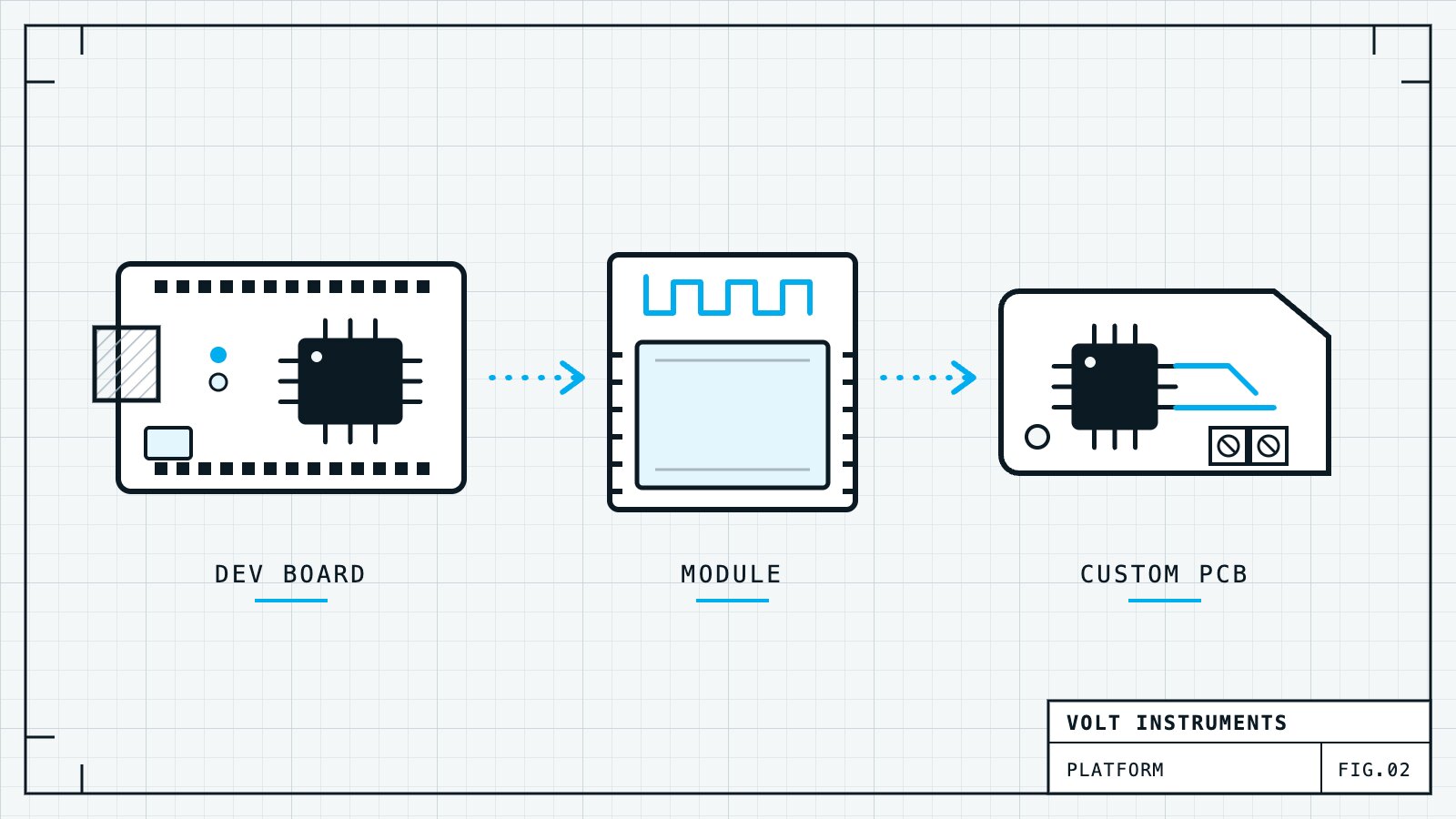
Many projects start on an Arduino or an ESP32 development board, and for good reason: they are cheap, easy to program and quick to wire up. The question we are asked most often is whether the final product can stay on that board or needs a custom design. The honest answer is that it depends on how many you will make and where they will be used.
When a development board is the right choice
- You are proving that an idea works and the wiring will change every week.
- You need one or two units for a demonstration, a lab or a college project.
- The device sits indoors, on a bench, and someone can reset it if it hangs.
In these cases a development board plus a neat enclosure is often the fastest and cheapest route.
Arduino or ESP32?
Classic Arduino boards based on 8-bit microcontrollers are simple, robust and well documented, and they are a good fit for switching relays, reading sensors and driving small displays. The ESP32 adds Wi-Fi and Bluetooth, much more memory and processing power, which matters when the device has to report data to a phone or a server, or handle many tasks at once. If you do not need wireless, the extra complexity of the ESP32 is not always worth it.
Signs it is time for a custom board
- Reliability: jumper wires, loose headers and breadboards do not survive vibration, heat or years of use.
- Size: the development board plus add-on modules no longer fit the enclosure.
- Cost: once you make tens or hundreds of units, a single board with only the parts you need usually costs less than a development board plus modules.
- Power: battery products need control over every milliamp, which development boards with their extra LEDs and regulators make difficult.
- Protection: field devices need proper protection against voltage spikes, reverse polarity and electrical noise.
Keeping your firmware
Moving to a custom board does not mean starting again. In most cases we design the new board around the same microcontroller family, so the firmware you or we wrote for the prototype carries over with small changes. See our embedded systems page for how we handle firmware, and electronic R&D if the idea is still taking shape.
Not sure which way to go? Send us your brief or call the workshop on +91 80537 03030.